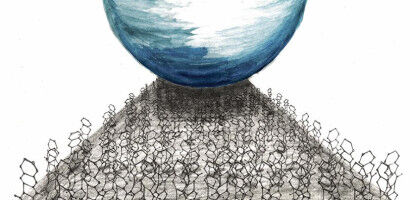
Analysis: Is love just a fleeting high fuelled by brain chemicals?
Attempts to reduce love down to one simple cause, whether pheromones or fate, are misguided and romantic love is more complex than simple science, explains Professor Parashkev Nachev (UCL Queen Square Institute of Neurology). It is no accident that arguably the most erotic line of English poetry is all prepositions. The essence of love, at least of passionately romantic love, is revealed in its very grammar. We fall in love, not wander into it. And, as you say, we fall head over heels, not dragging our feet - often at first sight rather than on careful inspection. We fall in love madly, blind to the other's vices, not in rational appraisal of their virtues. At its root, romantic love is spontaneous, overwhelming, irresistible, ballistic, even if, over time, its branches take on more complex hues. It is in control of us more than we are ever in control of it. In one sense a mystery, it is in another pure simplicity - its course, once engaged, predictable and inevitable and its cultural expression more or less uniform across time and space. The impulse to think of it in terms of simple causes precedes science. Consider the arrow of Cupid, the potion of a sorcerer - love seems elemental. Yet love is not easily conquered by science. Let us look at why. Sex pheromones, chemicals designed to broadcast reproductive availability to others, are often quoted as key instruments of attraction. It is an appealing idea. But while pheromones play an important role in insect communication, there is very little evidence that they even exist in humans. If a chemical can signal attraction outside the body, why not inside it?