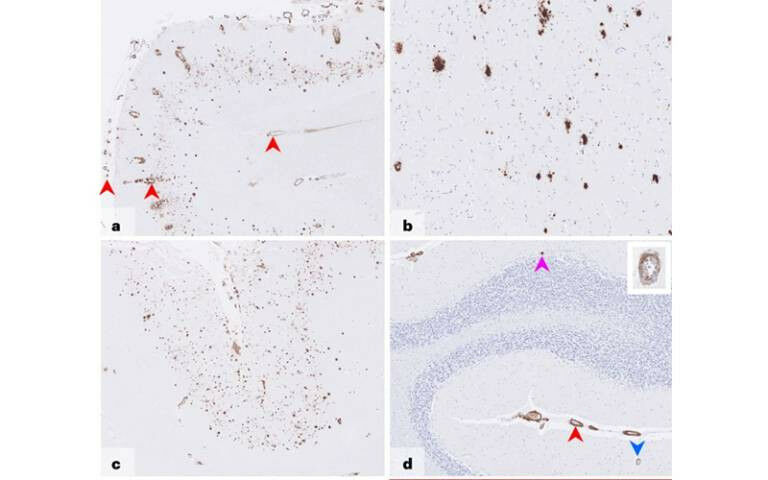
Amyloid deposits in brain - Amyloid deposition in brain tissue, seen in post-mortem analysis (figure from Nature Medicine paper )
Amyloid deposits in brain - Amyloid deposition in brain tissue, seen in post-mortem analysis (figure from Nature Medicine paper ) Five cases of Alzheimer's disease are believed to have arisen as a result of medical treatments decades earlier, reports a team of UCL and UCLH researchers. Alzheimer's disease is caused by the amyloid-beta protein, and is usually a sporadic condition of late adult life, or more rarely an inherited condition that occurs due to a faulty gene. The new Nature Medicine paper provides the first evidence of Alzheimer's disease in living people that appears to have been medically acquired and due to transmission of the amyloid-beta protein. The people described in the paper had all been treated as children with a type of human growth hormone extracted from pituitary glands from deceased individuals (cadaver-derived human growth hormone or c'hGH). This was used to treat at least 1,848 people in the UK between 1959 and 1985, and used for various causes of short stature. It was withdrawn in 1985 after it was recognised that some c'hGH batches were contaminated with prions (infectious proteins) which had caused Creutzfeldt-Jakob disease (CJD) in some people. c'hGH was then replaced with synthetic growth hormone that did not carry the risk of transmitting CJD.
TO READ THIS ARTICLE, CREATE YOUR ACCOUNT
And extend your reading, free of charge and with no commitment.