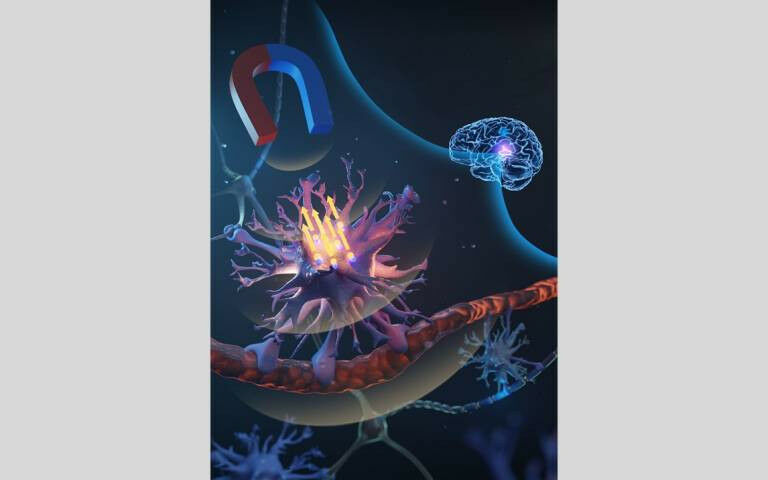
Graphic illustration of magnetomechanical stimulation - Graphic illustration of magnetomechanical stimulation or MMS, credit: Yichao Yu and Mark Lythgoe at UCL.
Graphic illustration of magnetomechanical stimulation - Graphic illustration of magnetomechanical stimulation or MMS , credit: Yichao Yu and Mark Lythgoe at UCL. Scientists at UCL have developed a new technique that uses microscopic magnetic particles to remotely activate brain cells; researchers say the discovery in rats could potentially lead to the development of a new class of non-invasive therapies for neurological disorders. Published in Advanced Science , the pioneering technique called "magnetomechanical stimulation" or MMS, allows touch sensitive brain glial cells called astrocytes to be stimulated with a magnetic device outside the body. Microscopic magnetic particles, or micromagnets, are attached to astrocytes, and used as miniature mechanical switches that can turn "on" the cells when a strong magnet is placed near the head. Co-author, Professor Alexander Gourine (UCL Centre for Cardiovascular and Metabolic Neuroscience) said: "Astrocytes are star-shaped cells found throughout the brain. They are strategically positioned between the brain blood vessels and nerve cells. These cells provide neurons with essential metabolic and structural support, modulate neuronal circuit activity and may also function as versatile surveyors of brain milieu, tuned to sense conditions of potential metabolic insufficiency.
TO READ THIS ARTICLE, CREATE YOUR ACCOUNT
And extend your reading, free of charge and with no commitment.