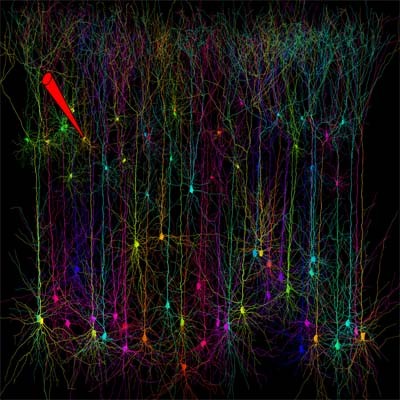
A schematic diagram showing the experimental approach, where a patch-clamp electrode is used to make a recording from a single pyramidal neuron.
Next time your brain plays tricks on you the brain is intrinsically unreliable. This may not seem surprising to most of us, but it has puzzled neuroscientists for decades. Given that the brain is the most powerful computing device known, how can it perform so well even though the behaviour of its circuits is variable? A long-standing hypothesis is that the brain's circuitry actually is reliable - and the apparently high variability is because your brain is engaged in many tasks simultaneously, which affect each other. It is this hypothesis that the researchers at UCL tested directly. The team - a collaboration between experimentalists at the Wolfson Institute for Biomedical Research and a theorist, Peter Latham, at the Gatsby Computational Neuroscience Unit - took inspiration from the celebrated butterfly effect - the idea that the flap of a butterfly's wings in Brazil could set off a tornado in Texas. Their strategy was to introduce a small perturbation into the brain, the neural equivalent of butterfly wings, and ask what would happen to the activity in the circuit. Would the perturbation grow and have a knock-on effect, thus affecting the rest of the brain, or immediately die out? It turned out to have a huge knock-on effect.
TO READ THIS ARTICLE, CREATE YOUR ACCOUNT
And extend your reading, free of charge and with no commitment.