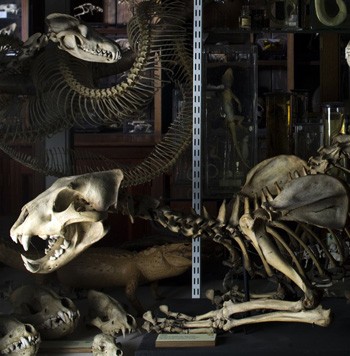
Lion skeleton in a case of carnivores. Most of the Museum’s main displays are arranged so that the species are displayed with their closest relatives. Credit: UCL Grant Museum of Zoology/Matt Clayton
UCL's Grant Museum of Zoology reopens on 15 March, allowing some of the rarest extinct animal specimens in the world to be displayed for the first time. Previously lost dodo bones, the remains of a quagga (an extinct species of half-striped zebra) and a giant Irish elk with antlers measuring nearly 3 metres across, are among the 70,000 specimens that can be seen in the new museum space. It still holds many specimens collected by Robert Edmond Grant, the first professor of zoology and comparative anatomy in England. Because of the age of the collection, many of the species in the museum are now endangered or extinct. UCL Professor of Genetics, Steve Jones, said: 'Dylan Thomas described Swansea Museum as 'a museum that should have been in a museum'. That was meant as somewhat of an insult, but for the Grant Museum it is praise indeed: a restored Victorian treasure-house crammed with specimens from a bottle of preserved moles to extinct zebras and (just identified) the legs of a dodo. And all this was put together by the man that taught zoology to Charles Darwin - which means, I am sure, that this will become a standard stop on the London tourist trail.' The Museum is also turning to cutting-edge technology to look at how visitors can interact with objects and uncover deeper themes about natural history. Dotted alongside displays of stuffed chimpanzees and huge anaconda skeletons are iPads, asking provocative questions about the ways museums operate and the role of science in society. The first questions the museum is asking its visitors to answer include: 'What makes an animal British'', 'Can keeping pets be justified given their impact on wildlife'', 'Should science shy away from studying biological differences between races'?
TO READ THIS ARTICLE, CREATE YOUR ACCOUNT
And extend your reading, free of charge and with no commitment.