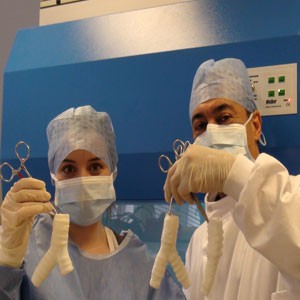
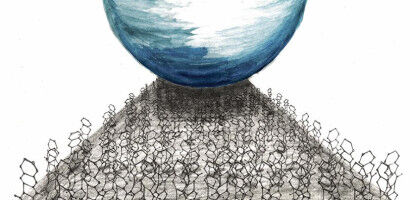
(Top) Claire Crowley and Professor Seifalian with the synthetic windpipe. (Bottom) The windpipe after the stem cells have been incorporated,
just before transplantation.
A UCL scientist and his team designed and built the synthetic windpipe 'scaffold' used in an operation in Sweden announced by the Karolinska University Hospital and Karolinska Institutet today. The windpipe (trachea) implanted in this patient was developed using nanocomposite materials which were developed and patented by Professor Alexander Seifalian (UCL Division of Surgery & Interventional Science), whose labs are based at the Royal Free Hospital. Together with Professor Paolo Macchiarini at Karolinska, who also holds an Honorary appointment at UCL, Professor Seifalian designed and developed the trachea scaffold using a material known as a novel nanocomposite polymer. Professor Seifalian has worked closely with UCL Business (UCLB), responsible for technology development and commercial transactions at UCL, to patent these materials and develop their use in medical devices. As well as being used for tissue scaffolds, the materials have other potential uses such as coronary stents and grafts. A nanocomposite is a material containing some components that are less than 100 nanometres (nm) in size. To give a sense of scale, a human hair is about 60,000 nanometres in thickness.
TO READ THIS ARTICLE, CREATE YOUR ACCOUNT
And extend your reading, free of charge and with no commitment.