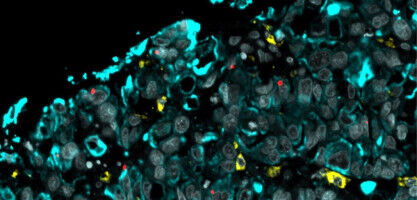
Three UCL scientists have been awarded prestigious European Research Council (ERC) Synergy Grants 2025 to support research into how lung cancer spreads and how the brain controls instinctive behaviours.
The ERC, set up by the European Union in 2007, is the premier European funding organisation for excellent frontier research.
After a highly competitive application process, 66 research teams involving 239 scientists will receive a total of €684 million in ERC Synergy Grants - averaging over €10m for each project - to tackle major scientific challenges across a broad range of fields.
UCL recipients and their projects:
Professor Mariam Jamal-Hanjani and Professor Nicholas McGranahan (both UCL Cancer Institute). The LUng cancer Metastasis Evolutionary Studies, known as LUMES, is an international project focusing on lung adenocarcinomas, a type of lung cancer, and its metastasis - the process by which cancer spreads from the primary place where it first formed to another part of the body.
The research group, which includes colleagues at the University of British Columbia and KTH Royal Institute of Technology in Stockholm, will receive nearly €12 million in a six-year grant.
Using a large group of cancer patients, the scientists will map where different cancer cell groups are located and how they spread and interact with the immune system and individual cells.
Alongside blood samples, the researchers will use advanced computer models and artificial intelligence to build a detailed lung cancer dataset which can be used to facilitate future studies and other cancer types.
In a joint statement, Professor Mariam Jamal-Hanjani and Professor Nicholas McGranahan, commented: "We are incredibly excited to embark on this body of work in which we will study the biological processes driving lethal metastatic disease in lung cancer, and we are grateful for the ERC Synergy programme for making this possible."
Professor Tiago Branco (Sainsbury Wellcome Centre at UCL).The biology of innate behaviour project, known as t’he INSTINCT project, is studying how the brain controls instinctive behaviour across species and has the potential to aid our understanding of mental health issues and compulsive behaviour patterns such as obesity and anxiety.
The INSTINCT project is a collaboration of three research groups at the University of Cambridge (the lead institution), UCL and the Baylor College of Medicine in Houston, Texas. The team has been awarded a €10 million, six-year grant to help uncover the brain circuits which control instinctive behaviour in both mice and humans.
During their lab work, the researchers will use high-resolution brain scans to visualise how the brain works in response to stress or when a person is hungry or full. They’ll also explore how the same genetic changes affect the metabolism of mice and their behaviour in natural social settings.
Professor Tiago Branco said: "By coming together, our research group can take on a challenge that no one researcher could address on their own. Our studies have the potential to transform societal understanding of the biological contribution to human behaviour - often expressed as the age-old debate between nature and nurture."
Professor Maria Leptin, President of the ERC, said: "Collaboration is at the heart of the ERC Synergy Grants. In our latest round, teams of researchers will join forces to address the most complex scientific problems together. This time, they are more international than ever.
"The competition was fierce, with many outstanding proposals left unfunded. With more funds, the ERC could fully capitalise on this wealth of first-class science. Such scientific endeavours are what Europe needs to be at the real forefront."
- University College London, Gower Street, London, WC1E 6BT (0) 20 7679 2000