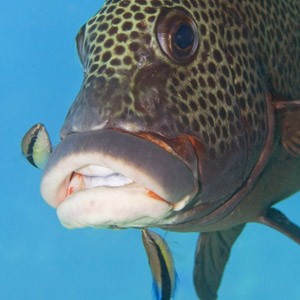
Two cleaner fish servicing a ’client’ (Credit: João Paulo Krajewski)
Familiarity with your partner is usually thought to promote teamwork, but new research has found that on coral reefs at least, female cleaner fish are more cooperative with unfamiliar males than their breeding partner. Published today in Proceedings of the Royal Society B , UCL researchers found that the unusual result was down to the power dynamic between male and female cleaner fish, with physically dominant males often punishing females in order to keep them in line. Unfamiliar males are more aggressive towards their female work partners, leading to more submissive, cooperative behaviour. In comparison, males who work with females they also breed with tend to treat their partners more leniently, leading to selfish and risky behaviour from the female fish. Raihani, lead author from the UCL Research Department of Genetics, Evolution and Environment, said: "The fact that males were more aggressive to unfamiliar females meant that females were most likely to 'cheat' if they were paired with their familiar male partner. This led to the slightly counter-intuitive result that familiarity with a partner results in decreased cooperation in this species." Cleaner fish ( Labroides dimidiatus ) live on coral reefs in the Indo-Pacific Ocean and provide a service to other fish living on the reef - known by biologists as 'clients' - by removing bits of dead skin and parasites. Although cleaner fish prefer to dine on mucus, feeding on living tissue is harmful to their clients.
TO READ THIS ARTICLE, CREATE YOUR ACCOUNT
And extend your reading, free of charge and with no commitment.