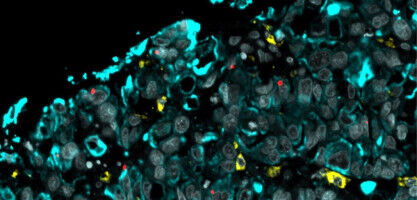
A previously unknown chain of molecular signals that determines how strongly the body’s immune system responds to viral infection has been discovered by scientists at UCL and the University of Cologne.
Pattern recognition receptors act as sensors in the body’s immune system that detect the molecular signatures of invading viruses and bacteria. When an invader is detected, they trigger the production of interferons - proteins that coordinate the body’s antiviral immune responses. However, the process of how signals from interferons are relayed inside cells has remained unclear.
In a new study published in Nature Cell Biology, an international team led by Professor Henning Walczak (UCL Cancer Institute and the University of Cologne) and Dr Eva Rieser from the University of Cologne has identified an enzyme called "ANKIB1" which plays a key role in this process.
Researchers found that this enzyme adds a small molecular tag known as "K11-linked ubiquitination" to proteins inside the cell, creating a platform that helps other proteins gather and switch on interferons, thus organising the body’s immune defence.
Cells use small protein tags called ubiquitin to organise and direct these signals, and until now, only two types of these ubiquitin tags were known to play a role in immune signalling. The study shows that this new third type, K11-linked ubiquitin, is also important.
K11-linked ubiquitin acts as a regulatory ’switch’ in the immune system which could help researchers develop new treatments for inflammatory diseases, viral infections, cancer and neurodegenerative disorders.
Experiments in cell cultures and animal models confirmed that ANKIB1 is essential for fighting viral infections. Mice lacking the enzyme were unable to produce an interferon response to herpes simplex virus I and died from the infection.
Conversely, removing ANKIB1 also protected mice in a model of severe inflammatory disease caused by too much interferon, highlighting its dual role in both protective and pathological immune responses.
The study also identified a signalling axis (a pathway of molecular interactions) called "ANKIB1-K11 ubiquitin-OPTN-TBK1-IRF3", which drives interferon production and influences how strong the body’s immune response is.
Together, these discoveries help scientists better understand how cells control immune signals. They could also be important for diseases beyond viral infections, including cancer and neurological disorders. Many tumours take advantage of immune signals to avoid being attacked by the immune system. At the same time, long-lasting interferon signals in the brain have been linked to diseases such as Alzheimer’s and Parkinson’s.
Lead author Professor Henning Walczak said: "We discovered that ANKIB1 decides when the alarm clock for immune cells sounds and, importantly, how loud this wake-up call will be.
"Our study provides fundamental insight into how the immune system regulates antiviral defences and inflammatory responses. By identifying ANKIB1 as a central molecular ’switch’ controlling interferon production, the study opens new possibilities for therapeutic intervention."
Co-senior author Dr Eva Rieser of the University of Cologne added: "With K63- and M1-ubiquitin, so far only two letters of the ubiquitin signalling code were known. With the discovery of K11-ubiquitin as the third letter of the ubiquitin alphabet, we are now a decisive step closer to the deciphering of the ubiquitin code of cellular signalling."
- University College London, Gower Street, London, WC1E 6BT (0) 20 7679 2000