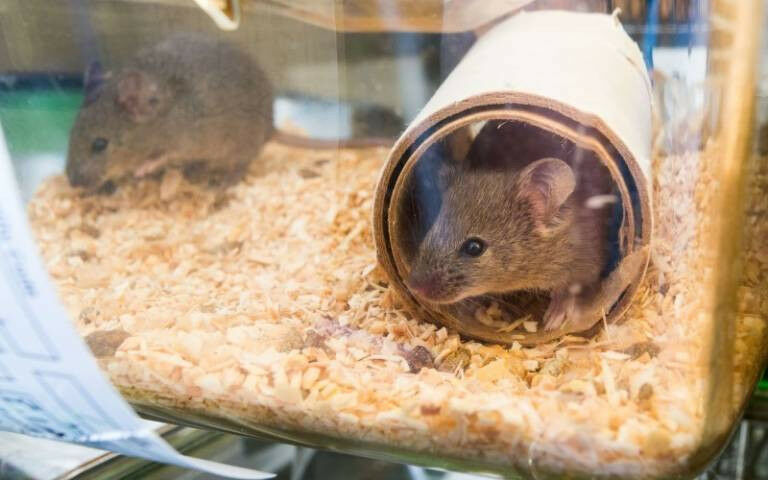
Research mice - Research mice at UCL (Credit: David Bishop, UCL)
Research mice - Research mice at UCL (Credit: David Bishop, UCL) Mice do not need previous experience of threat in order to respond to danger by choosing the shortest possible escape route, finds a new study led by UCL researchers. In the new Current Biology study, the researchers show that mice can learn the shortest route to escape after only 10 minutes of exploring a new environment. Lead author Professor Tiago Branco (Sainsbury Wellcome Centre at UCL) said: "In many neuroscience studies, mice are trained to solve complex mazes and are given lots of time to learn how to do so. But in nature, mice do not have that luxury - when faced with threat, they must escape to shelter as quickly as possible. The question is how do mice learn this very quickly, without the opportunity of trial and error." To explore this question, the researchers carried out a series of behavioural experiments where they gave mice a choice of two or three routes back to a shelter. The scientists used a loud sound or looming stimulus, simulating a predator, to scare the mice and then observed their route back to shelter. Firstly, the neuroscientists blocked the direct path to shelter and found that the mice learned to use one of the other routes.
TO READ THIS ARTICLE, CREATE YOUR ACCOUNT
And extend your reading, free of charge and with no commitment.