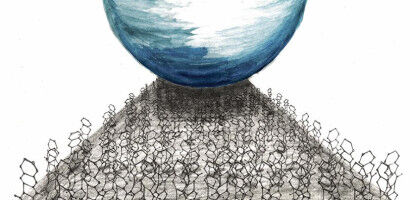
Structure of C16-IDTBT, an organic polymer Credit: Deepak Venkateshvaran
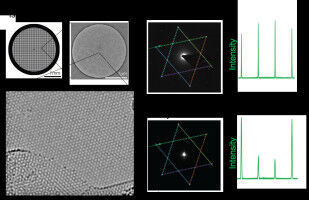
Structure of C16-IDTBT, an organic polymer Credit: Deepak Venkateshvaran Researchers have analysed the properties of an organic polymer with potential applications in flexible electronics and uncovered variations in hardness at the nanoscale, the first time such a fine structure has been observed in this type of material. The field of organic electronics has benefited from the discovery of new semiconducting polymers with molecular backbones that are resilient to twists and bends, meaning they can transport charge even if they are flexed into different shapes. It had been assumed that these materials resemble a plate of spaghetti at the molecular scale, without any long-range order. However, an international team of researchers found that for at least one such material, there are tiny pockets of order within. These ordered pockets, just a few ten-billionths of a metre across, are stiffer than the rest of the material, giving it a -fruitcake- structure with harder and softer regions. The work was led by the University of Cambridge and Park Systems UK Limited, with KTH Stockholm in Sweden, the Universities of Namur and Mons in Belgium, and Wake Forest University in the USA. Their results could be used in the development of next-generation microelectronic and bioelectronic devices.
TO READ THIS ARTICLE, CREATE YOUR ACCOUNT
And extend your reading, free of charge and with no commitment.