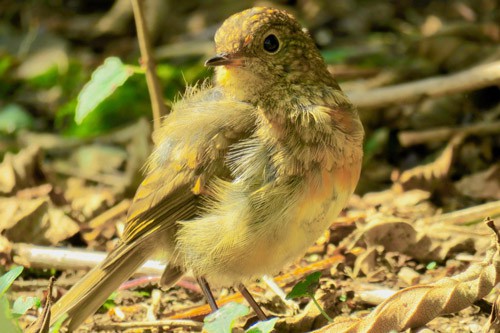
Fossils complete our view on the tree of life and can show that this robin is a dinosaur!
Mark Puttick
A team of scientists from the University of Bristol has suggested that we need to use a fresh approach to analyse relationships in the fossil record to show how all living and extinct species are related in the 'tree of life'. The researchers from the Bristol Palaeobiology Group , part of the School of Earth Sciences , studied the best way to understand relationships of extinct animals to other extinct species as well as those alive today. The team's paper, published today in Proceedings of the Royal Society B, clarifies the most effective way to look at evolutionary relationships in the fossil record, and application of this method could change the way we look at the history of life. Lead researcher Dr Mark Puttick from the Natural History Museum and University of Bristol explained: "When a new fossil species is discovered we naturally want to know where it fits in the tree of life. "Our results show that the default method that has been used to do this for the past few decades is not always accurate, and so re-analysis with better approaches could lead to profoundly different conclusions about how we see the evolutionary history." The relationships of extinct species are understood by studying their similarities and differences in their fossilised skeletons. The most-widely used method called parsimony produces family trees by minimising the relative number of skeletal differences between species to group animals into nested groups - the closer the grouping, the closer the relationship.
TO READ THIS ARTICLE, CREATE YOUR ACCOUNT
And extend your reading, free of charge and with no commitment.