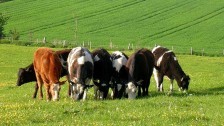
Cattle Credit: Dachalan (Flickr Creative Commons)
Each year thousands of cattle are slaughtered to control the spread of bovine tuberculosis. New research reveals that testing misses many animals harbouring the disease and shows that large herds are particularly vulnerable to rapid transmission. Around 38 per cent of herds that are cleared experience a recurrent incident within 24 months, suggesting that infection may be persisting within herds." - —Dr Andrew Conlan A team of scientists has used mathematical tools to develop models for estimating the efficiency of cattle-based controls for bovine tuberculosis (bTB). These models will help policy-makers to understand, and thus to control, a disease which costs the UK taxpayer around £91 million per annum for testing, slaughter of animals and compensation to farmers. The models built by the team represent an advance over previous models as they are informed directly by extensive data on reported incidence and spread of the disease, rather than expert opinion. Importantly, they provide a first estimate of the quantity of infection missed by cattle testing and the contribution of this hidden burden of infection to the persistence of bTB within herds. Applied to recent data, the models suggest that around one in five of British herds that have been cleared of restrictions, following testing for bTB, may harbour the infection.
TO READ THIS ARTICLE, CREATE YOUR ACCOUNT
And extend your reading, free of charge and with no commitment.