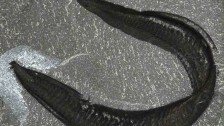
Pikaia gracilens Image credit J.B. Caron
Most primitive known vertebrate and therefore the ancestor of all descendant vertebrates, including humans, discovered. The discovery of myomeres is the smoking gun that we have long been seeking. said the study's lead author, Professor Simon Conway Morris of the University of Cambridge." - — Professor Simon Conway Morris of the University of Cambridge's Department of Earth Sciences Researchers from the University of Cambridge, University of Toronto and the Royal Ontario Museum (ROM) have confirmed that a 505 million-year-old creature, found only in the Burgess Shale fossil beds in Canada's Yoho National Park, is the most primitive known vertebrate and therefore the ancestor of all descendant vertebrates, including humans. The research team's analysis proves the extinct Pikaia gracilens is the most primitive member of the chordate family, the group of animals that today includes fish, amphibians, birds, reptiles and mammals. The study is based on the analysis of 114 specimens and was published yesterday, 05 March, in the British scientific journal Biological Reviews . Pikaia was first described, on the basis of only a few specimens, by American palaeontologist Charles Doolittle Walcott in 1911 as a possible annelid worm, a group that includes today's leeches and earthworms. However, scientists have long speculated that Pikaia was a chordate because it appeared to have a very primitive notochord - a flexible rod found in the embryos of all chordates - which goes on to make up part of the backbone in vertebrates.
TO READ THIS ARTICLE, CREATE YOUR ACCOUNT
And extend your reading, free of charge and with no commitment.