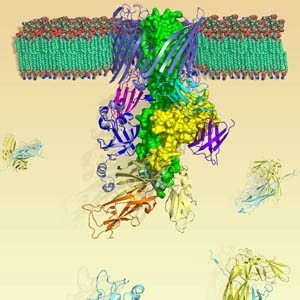
Structure of the FimD protein complex
Scientists have uncovered the structure of the protein complex that assembles the tiny hair-like strands that cover the outside of bacteria. Called pili, these 'hairs' allow bacteria to group together and stick to human cells to cause infection - and are therefore a key target for a new generation of antibiotics. Scientists at the Institute of Structural and Molecular Biology (a joint institute between University College London (UCL) and Birkbeck) have revealed the structure of a complex protein called FimD that acts as an assembly platform for the pili of cystitis bacteria. The structure of the FimD protein means scientists can see the process of pili assembly, from individual protein subunits to complete structures, for the first time. Pili are tiny hair-like strands on the outside of bacteria that help them to link together in groups. In the case of cystitis, pili allow bacteria to attach themselves to the wall of the bladder, leading to bladder cells engulfing the bacterium. Once the bacteria have invaded the bladder cells, they escape traditional antibiotic treatment and lie dormant, making recurrent infections very common.
TO READ THIS ARTICLE, CREATE YOUR ACCOUNT
And extend your reading, free of charge and with no commitment.