Hard-to-find fish reveals shared developmental toolbox of evolution
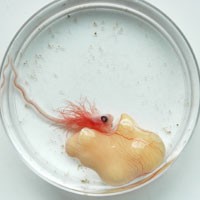
A SCUBA expedition in Australia and New Zealand to find the rare embryos of an unusual shark cousin enabled American and British researchers to confirm new developmental similarities between fish and mammals. Elephant fish, a relative of sharks, utilize the same genetic process for forming skeletal gill covers that lizards and mammals use to form fingers and toes, researchers at the Universities of Cambridge and Chicago found. The precise timing of when and where that gene is expressed during embryonic development produces dramatic anatomical differences between elephant fish and their close relatives, the dogfish. S.A, confirms that organisms separated by hundreds of millions of years of evolution share similar genetic programs for body formation. "The research highlights how evolution is extremely efficient, taking advantage of preexisting mechanisms, rather than inventing new ones," said Dr Andrew Gillis at the University of Cambridge's Department of Physiology, Development and Neuroscience and lead author. "By simply tinkering with the timing of when or where a gene is expressed in an embryo, you can get very different anatomical outcomes in adults." "You have a common nail that's used for many different pieces of furniture," said Dr Neil Shubin, Robert R. Bensley Professor of Organismal Biology & Anatomy at the University of Chicago and senior author of the paper. "This esoteric fish with this esoteric anatomical system is showing us something very fundamental about the evolutionary tree: that there's a common process at work among disparate types of organisms." The holocephalans are a family of fish that share a cartilage-based skeleton with better known animals such as sharks and rays.
TO READ THIS ARTICLE, CREATE YOUR ACCOUNT
And extend your reading, free of charge and with no commitment.