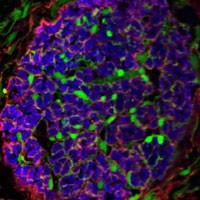
Origin of cells associated with nerve repair discovered
Scientists have discovered the origin of a unique type of cell known for its ability to support regeneration in the central nervous system. Their findings raise the possibility of obtaining a more reliable source of these cells for use in cell transplantation therapy for spinal cord injuries. Olfactory ensheathing cells (OECs), as the name suggests, ensheath and protect the nerve fibres in the olfactory nerve, which transmit olfactory (smell) information to the brain from receptor cells sitting in the lining of the nose. Excitingly, OECs can promote nerve repair when transplanted into the damaged spinal cord. They can also be grown in dishes from pieces of nasal lining but, unfortunately, in such small quantities that this may not be a viable option for use in treatments. Dr Clare Baker, from the Department of Physiology, Development and Neuroscience at the University of Cambridge, lead author of the study, said: "In theory, one should be able to purify OECs from a patient's nose and transplant them into the damaged spinal cord to promote nerve repair, without any fear of graft rejection. "Unfortunately, there aren't very many OECs in the nasal lining, and this tissue also contains other peripheral nerve fibres, ensheathed by cells that look very similar to OECs but which are less effective at promoting spinal cord repair.
TO READ THIS ARTICLE, CREATE YOUR ACCOUNT
And extend your reading, free of charge and with no commitment.