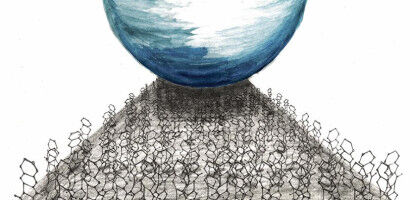
New solution for making 2D nanomaterials
Two-dimensional (2D) nanomaterials have been made by dissolving layered materials in liquids, according to new UCL-led research. The liquids can be used to apply the 2D nanomaterials over large areas and at low costs, enabling a variety of important future applications. 2D nanomaterials, such as graphene, have the potential to revolutionise technology through their remarkable physical properties, but their translation into real world applications has been limited due to the challenges of making and manipulating 2D nanomaterials on an industrial scale. The new approach, published today , produced single layers of many 2D nanomaterials in a scalable way. The researchers used the method on a wide variety of materials, including those with semiconductor and thermoelectric properties, to create 2D materials that could be used in solar cells or for turning wasted heat energy into electrical energy, for example. '2D nanomaterials have outstanding properties and a unique size, which suggests they could be used in everything from computer displays to batteries to smart textiles. Many methods for making and applying 2D nanomaterials are difficult to scale or can damage the material, but we've successfully addressed some of these issues.