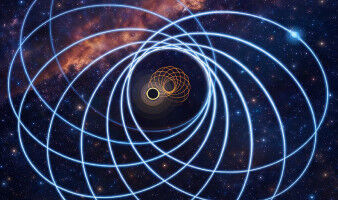
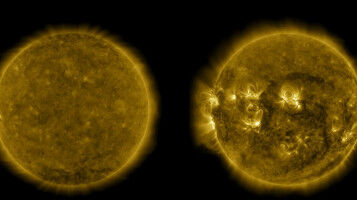
Image showing a family of trees in our solar system, including the Sun
Credit: Institute of Astronomy
Astronomers are borrowing principles applied in biology and archaeology to build a family tree of the stars in the galaxy. By studying chemical signatures found in the stars, they are piecing together these evolutionary trees looking at how the stars formed and how they are connected to each other. The signatures act as a proxy for DNA sequences. It's akin to chemical tagging of stars and forms the basis of a discipline astronomers refer to as Galactic archaeology. The branches of the tree serve to inform us about the stars' shared history - Dr Paula Jofré It was Charles Darwin, who, in 1859 published his revolutionary theory that all life forms are descended from one common ancestor. This theory has informed evolutionary biology ever since but it was a chance encounter between an astronomer and an biologist over dinner at King's College in Cambridge that got the astronomer thinking about how it could be applied to stars in the Milky Way. Writing in Monthly Notices of the Royal Astronomical Society , Dr Paula Jofré, of the University of Cambridge's Institute of Astronomy, describes how she set about creating a phylogenetic 'tree of life' that connects a number of stars in the galaxy.
TO READ THIS ARTICLE, CREATE YOUR ACCOUNT
And extend your reading, free of charge and with no commitment.