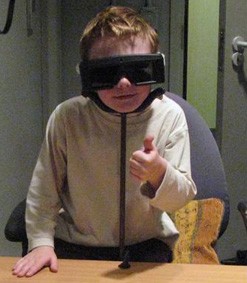
A participant in the vision study. Credit: Marko Nardini.
Unlike adults, children are able to keep information from their senses separate and may therefore perceive the visual world differently, according to research published today. Scientists at UCL (University College London) and Birkbeck, University of London have found that children younger than 12 do not combine different sensory information to make sense of the world as adults do. This does not only apply to combining different senses, such as vision and sound, but also to the different information the brain receives when looking at a scene with one eye compared to both eyes. The results imply that children's experience of the visual world is very different to that of adults. Dr Marko Nardini, UCL Institute of Ophthalmology, and lead author said, 'To make sense of the world we rely on many different kinds of information. A benefit of combining information across different senses is that we can determine what is out there more accurately than by using any single sense.' He added: 'The same is true for different kinds of information within a single sense. Within vision there are several ways to perceive depth.
TO READ THIS ARTICLE, CREATE YOUR ACCOUNT
And extend your reading, free of charge and with no commitment.