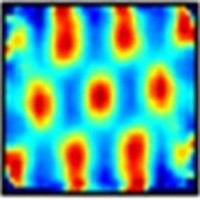
Firing pattern from a grid cell recorded on a flat surface. Credit: Kate Jeffery/UCL
Animal's brains are only roughly aware of how high-up they are in space, meaning that in terms of altitude the brain's 'map' of space is surprisingly flat, according to new research. In a study published online , scientists studied cells in or near a part of the brain called the hippocampus, which forms the brain's map of space, to see whether they were activated when rats climbed upwards. The study, supported by the Wellcome Trust, looked at two types of cells known to be involved in the brain's representation of space: grid cells, which measure distance, and place cells, which indicate location. Scientists found that only place cells were sensitive to the animal moving upwards in altitude, and even then only weakly so. Professor Kate Jeffery, lead author from UCL Psychology and Language Sciences, said: 'The implication is that our internal sense of space is actually rather flat ' we are very sensitive to where we are in horizontal space but only vaguely aware of how high we are. 'This finding is surprising and it has implications for situations in which people have to move freely in all three dimensions - divers, pilots and astronauts for example. It also raises the question - if our map of space is flat, then how do we navigate through complex environments so effectively?' How the hippocampus makes its map of space is fairly well understood for flat environments, but the world is of course not flat ' it has a richly varied topography, and a useful map therefore needs to work in all three dimensions.
TO READ THIS ARTICLE, CREATE YOUR ACCOUNT
And extend your reading, free of charge and with no commitment.