I am not an Egyptologist. Probably neither are you. But, like me, I bet you are captivated, or at least intrigue d, by ancient Egypt. Something about it - its aura, its grandeur, its aesthetic - has long held a powerful grip on the human imagination, particularly in the West where ’Egyptomania’ has influenced pop culture since the late 18th century.
My fascination began in childhood with a social studies project on Ramses II, regarded as one of ancient Egypt’s greatest pharaohs and known for commissioning some of its most significant and recognisable monuments. It deepened when, as a teenager in the mid-1990s, I was fortunate to visit Egypt and witness firsthand the great temple dedicated to him at Abu Simbel in the Nubian region that straddles both modern-day Egypt and Sudan.
But you don’t need to have studied or visited Egypt to experience its wonders. In fact, you don’t even need to leave the UCL campus. The Petrie Museum of Egyptian and Sudanese Archaeology , located in the heart of Bloomsbury, offers a remarkable window into the ancient world - and best of all, it’s free for everyone to visit, with no booking required.
Tucked between the Science Library and the Fold Pizza shop on Malet Place, the Petrie Museum attracts over 20,000 people per year and is home to over 80,000 artefacts , making it one of the world’s largest and most important collections of archaeological material from the Nile River Valley in what is now Egypt and Sudan. Among the relics on display are the Tarkhan dress (the world’s oldest woven garment dating to 3,000 BC),the earliest recorded veterinary treatise and will on (papyrus) paper, as well as some of the earliest mathematical calculations and architectural drawing. The museum is designated under the Arts Council England’s Designation Scheme as being of national and international importance in recognition of its role in deepening our understanding of the world’s shared cultural heritage.
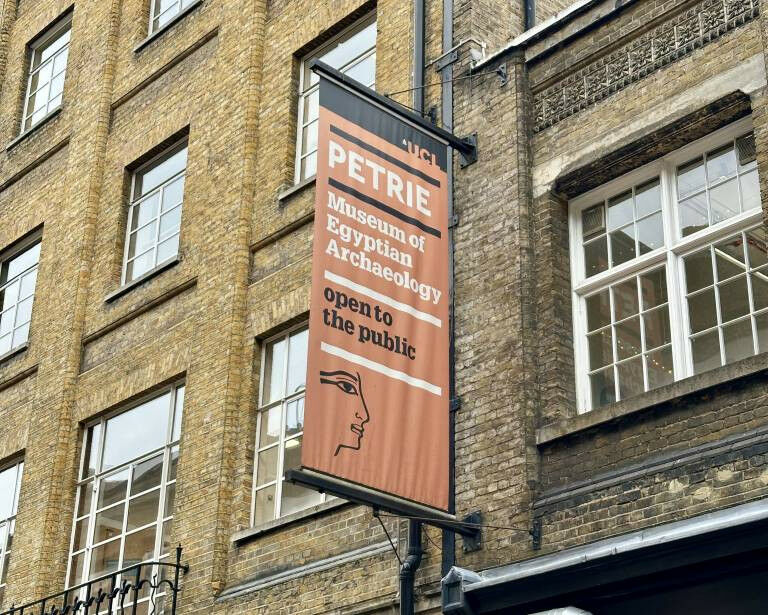
Despite housing such a significant collection, the museum itself remains something of a hidden gem. I have walked past the bright orange banner above the entrance many times before, but this time I ventured inside for the first time. As I ascend the entryway staircase, I am greeted with various quotes inscribed on the walls, notably from one of the museum’s founders, Sir William Matthew Flinders Petrie: "The treasure dug up is not gold, but history... Every day there is a new light on the past".
To uncover more about the museum’s role and significance, I spoke with Catriona Wilson, the Head of Collections. As I quickly learned, the museum represents more than a repository of ancient objects. It serves as an international hub for interdisciplinary research, where Egyptology and archaeology intersect with fields as diverse as arts, humanities, science and engineering.
Catriona’s team primarily delivers ’intellectual access’ - facilitating research and learning opportunities, both for academics and the general public through regular events like their ongoing monthly Research in Focus lecture series. In addition to a wealth of content related to kings and pharaohs, as you might expect, Catriona explains how items in their collection also reflect the lives of ordinary people, from millennia-old domestic tools, such as the "dancing girl cosmetic spoon’ used for mixing perfumes and make-up, to photos of Egyptians who worked on the excavations in the 19thand 20th-centuries. "Our collection and archive tell a broader story about the social history surrounding these objects," she says, "and about the relationships between them."
The museum forms part of a wider network on campus, including the Grant Museum of Zoology , the UCL Pathology Museum and UCL Art Museum. These institutions fall under the Libraries, Culture, Collections and Open Science (LCCOS) department, formerly UCL Culture. Its broad reach became evident as Catriona enthusiastically listed just some of their recent accomplishments. In collaboration with a team led by UCL’s Institute of Archaeology and Genetics Institute, researchers sequenced the genome of 3,000-year-old ancient Egyptian wheat-grain that had been stored in the museum since its excavation in 1924. Another team, led by UCL’s Centre for Digital Humanities, used innovative, non-destructive deep imaging techniques to read inscriptions imprinted on mummy cases that were previously invisible to the naked eye. These examples are just the tip of the pyramid.
Beyond these high-profile projects, the museum collaborates with various other UCL departments - including Laws, The Bartlett, the Institute of Education and Sustainable Heritage - highlighting its relevance beyond archaeology and demonstrating how ancient history can inform contemporary challenges. (The interdisciplinary nature of some of these collaborations are so novel and unorthodox that I almost wouldn’t be surprised if they inspired the publication of a book with a title like ’Business Secrets of the Pharaohs’).
Students in the Museum
The museum isn ’ t just a space for world-renowned researchers and scholars-it also plays a vital role in student learning. In 2024, Year 1 students from the Bartlett School of Architecture collaborated with museum curators to create six installations inspired by ancient Egyptian deities, daily rituals and mythical narratives. Their work explored how architectural craft can be informed by practices of preservation, reuse and adaptation.Students can also engage through extracurricular roles. One such person is Helga Beshiri - my fellow classmate in the MA Architectural History programme - who works part-time as a Museum Visitors’ Assistant. Originally from Brescia in Italy, Helga began as a volunteer at both the Petrie Museum and Grant Museum of Zoology after finishing her undergraduate studies in 2023. She now helps in various capacities, including welcoming visitors and helping coordinate school visits.
" Working here has been a lot of fun," Helga tells me. " And although I didn’t know much about Egyptology before I started, I’ve been learning quite a bit, either through the material they’ve given me, or through conversation with staff. For example, I just learned why some of the large water jugs have curved bases, which seems kind of counter-intuitive because they can’t stand upright on their own - it’s actually because they were buried in the sand to keep them cool. That’s one of the theories, at least."
Ultimately, she would like to continue working in the heritage sector in the UK after graduation. " I feel like this role is a good starting point for my career. I know I won’t be a museum curator tomorrow, but eventually that’s what I want to do - and this role provides me with the kind of experience that I need to help me get there."
Despite its focus on ancient history, the Petrie Museum is also deeply engaged with contemporary issues relevant to local communities. One recent example was their Sudan Living Cultures knowledge exchange programme, which sought to engage with London’s Sudanese diaspora. Three independent artists - Ahmed Akasha, Dina Nur Satti and Yasmin Elnour - were commissioned to create artwork inspired by the museum’s collection to highlight the value of preserving transgenerational knowledge through material culture.
" The artists wanted this programme to exhibit a theme of hope and hopefulness," says Catriona, referring to the ongoing civil war there. " A large amount of Sudan ’ s cultural heritage has been destroyed or looted in the last two years. Part of the motivation for this programme was to raise awareness and demonstrate why preservation of cultural heritage is so important."
Looking ahead, the museum plans to reassess its collection of Sudanese artefacts, with input from community partners, and redisplay them in 2026. And while the museum has maintained professional connections with the Sudan National Museum in Khartoum since its establishment in the 1950s, this raises complex questions. " A lot of important artefacts are stored here," Catriona acknowledges. " But should they be? How do we talk about that history? And how can we share them better? This is a big focus for us at the moment.
Before I left the museum, Catriona showed me her favourite photo from their current exhibition, Seeing and Unseeing the Pyramids (open until 28 June). Shot by American photojournalist and surrealist artist Lee Miller during her years living in Egypt in the 1930s, the image is of the Great Pyramid of Giza, but it offers an unusual perspective-rather than shot from the ground looking up to the top, she climbed to the top and shot the photo looking down and out at the shadow it cast across the landscape. ( " You couldn’t do this today," Catriona reminds me with a smile.)
" This photo captures something beyond the physical monument. It shows how Egypt’s history casts a long shadow over the world-it’s a legacy that remains with us today."
That legacy is one that is perfectly encapsulated through the Petrie Museum, from illuminating the mysteries of the ancient past to contextualizing contemporary issues at home and abroad.
Walking back down the staircase and out of the museum, I couldn’t help but reflect on that shadow in the photograph-the long reach of ancient Egypt, stretching across time and space, right into the heart of UCL.
About the author: UCL Student Storyteller Mark Bessoudo says : "I’m currently completing a one-year MA in Architectural History at the Bartlett School of Architecture. I’m originally from Canada but have been in London since 2019. I’m so excited to have been selected as one of UCL’s Student Storytellers. I’m looking forward to learning from journalists, interviewing academic researchers and other people at UCL who are involved in interesting initiatives to uncover the stories behind them, and then working with the UCL Communications Team to get the stories out to a wider audience."
- University College London, Gower Street, London, WC1E 6BT (0) 20 7679 2000