


Environment - Mar 27
The University of Manchester signs Memorandum of Understanding with United Utilities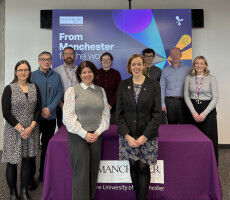
The University of Manchester signs Memorandum of Understanding with United Utilities
Agronomy & Food Science - Mar 27
Gather & Gather unveils fresh new Spring/Summer 2026 menu designed for the warmer seasons
Gather & Gather unveils fresh new Spring/Summer 2026 menu designed for the warmer seasons
Environment - Mar 26
University of Manchester hits major sustainability milestone, with Main Campus becoming 100% 'Zero Landfill'
University of Manchester hits major sustainability milestone, with Main Campus becoming 100% 'Zero Landfill'
Campus - MANCHESTER - Mar 26
Manchester students mentor local teenagers to build confidence in applying for university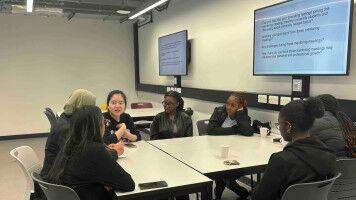
Manchester students mentor local teenagers to build confidence in applying for university

news
University College London
Results 2021 - 2040 of 2154.
Electroengineering - 18.05.2012

The first purely silicon oxide-based 'Resistive RAM' memory chip that can operate in ambient conditions - opening up the possibility of new super-fast memory - has been developed by researchers at UCL. Resistive RAM (or 'ReRAM') memory chips are based on materials, most often oxides of metals, whose electrical resistance changes when a voltage is applied - and they "remember" this change even when the power is turned off.
Life Sciences - Administration - 16.05.2012

An international collaborative study to map the genome of a South American butterfly has identified the secret behind its mimetic nature. The genome sequence of the Postman butterfly, Heliconius melpomene, was used as a reference to study species that live together in the Peruvian Amazon. Several of these share bright wing patterns in order to reinforce a warning signal that they are bad to eat - dissuading predators from attack.
Life Sciences - 09.05.2012
Men can rest easy - sex chromosomes are here to stay
Fears that sex-linked chromosomes, such as the male Y chromosome, are doomed to extinction have been refuted in a new genetic study which examines the sex chromosomes of chickens. The study looked at how genes on sex-linked chromosomes are passed down generations and linked to fertility, using the specific example of the W chromosome in female chickens.
Life Sciences - Health - 24.04.2012

Researchers in the UCL Wolfson Institute for Biomedical Research have made a discovery which could help the development of analgesic drugs able to treat nerve damage-related pain. The research is published today and funded by the Biotechnology and Biological Sciences Research Council (BBSRC). Current pain-killers work well for some types of pain, but are not very effective for easing the chronic pain associated with nerve damage.
Life Sciences - 12.04.2012
Pigeons’ homing skill not down to iron-rich beak cells
The theory that pigeons' famous skill at navigation is down to iron-rich nerve cells in their beaks has been disproved by a new study published in Nature. The study shows that iron-rich cells in the pigeon beak are in fact specialised white blood cells, called macrophages. This finding, which shatters the established dogma, puts the field back on course as the search for magnetic cells continues.
Life Sciences - Health - 05.03.2012

Antibodies that block the process of synapse disintegration in Alzheimer's disease have been identified, raising hopes for a treatment to combat early cognitive decline in the disease. Alzheimer's disease is characterized by abnormal deposits in the brain of the protein Amyloid-ß, which induces the loss of connections between neurons, called synapses.
Physics - Chemistry - 01.03.2012

Dione, one of Saturn's icy moons, has a weak exosphere which includes molecules of oxygen, according to new findings from the Cassini-Huygens mission. The international mission made the discovery using combined data from one of Cassini's instruments, called CAPS (Cassini Plasma Spectrometer), which includes a sensor designed and built at UCL's Mullard Space Science Laboratory.
Economics - 08.02.2012
Public opinion on immigration policy more related to cultural than economic concerns
Public attitudes toward immigration policy are more influenced by cultural and social concerns than economic ones such as wages and taxes, according to new UCL research. The research, conducted by David Card, Christian Dustmann and Ian Preston from the UCL Centre for Research and Analysis of Migration (CReAM) analyses the main factors that drive public opposition to immigration.
Health - Life Sciences - 08.12.2011
Personalised treatment for Crohn’s Disease a step closer following gene mapping
Three new locations for Crohn's Disease genes have been uncovered by scientists at UCL using a novel gene mapping approach. The complex genetic and environmental causes of Crohn's Disease (CD) have long been difficult to untangle. CD, a type of Inflammatory Bowel Disease that affects about 100 to 150 people per 100,000 in Europe, is characterised by inflammation in the gastrointestinal tract.
Health - History & Archeology - 29.11.2011
Do we need a ’science of evidence’?
Evidence is key to many topical debates such as global warming, evolution, the search for weapons of mass destruction, DNA profiling, and advances in science and medicine. A new book asks whether, considering the importance of evidence for so many disciplines, a general 'science of evidence' is possible - or even desirable.
Life Sciences - 22.09.2011

Sirtuins, proteins believed to significantly increase lifespan in a number of organisms - and the claimed target of some anti-ageing creams - do not, in fact, affect animal longevity, according to new research funded by the Wellcome Trust and the European Union. Sirtuins had previously been linked to ageing and longevity in yeast, the nematode worm and the fruit fly, organisms commonly used as models for the biology of human ageing.
Mechanical Engineering - Life Sciences - 20.09.2011
New gene identified for familial motor neuron disease
Families suffering from a history of motor neuron disease have helped an international scientific team locate a new gene linked to the incurable disease. The investigators studied a large group of Finnish patients and a family from Gwent, South Wales who have lost many relatives to early onset motor neuron disease (MND) and the neurodegenerative disease fronto-temporal dementia, also known as Pick's disease.
Life Sciences - Health - 08.09.2011
Babies distinguish pain from touch at 35-37 weeks
Babies can distinguish painful stimuli as different from general touch from around 35-37 weeks gestation - just before an infant would normally be born - according to new research. In a study published online in the journal Current Biology, scientists show that neural activity in the brain gradually changes from an immature state to a more adult-like state from 35 weeks of development.
Electroengineering - Physics - 31.08.2011

UCL scientists are part of an international team which has developed a novel X-ray technique for imaging atomic displacements in materials with unprecedented accuracy. The team has applied the technique to determine how a recently discovered class of exotic materials - multiferroics - can be simultaneously both magnetically and electrically ordered.
Physics - Computer Science - 03.08.2011

The theory that our universe is contained inside a bubble, and that multiple alternative universes exist inside their own bubbles ' making up the 'multiverse' ' is, for the first time, being tested by physicists. Two research papers published in Physical Review Letters and Physical Review D are the first to detail how to search for signatures of other universes.
Health - Life Sciences - 25.07.2011
A team led by scientists at UCL, funded by the Medical Research Council (MRC) and AVI BioPharma, have made an important breakthrough in the development of a treatment for Duchenne Muscular Dystrophy (DMD). Together with the MDEX Consortium, chaired by Professor Francesco Muntoni (UCL Institute for Child Health), the group show in a paper published in The Lancet today that a gene-based drug treatment was effective in restoring the dystrophin protein that is missing in sufferers of DMD, in seven out of 19 trial participants.
Life Sciences - Earth Sciences - 21.07.2011

A fossil from north-eastern China has revealed that terrestrial reptiles were giving birth to live young at least as early as 120 million years ago. The newly discovered fossil of a pregnant lizard proves that some squamate reptiles (lizards and snakes) were giving birth to live young, rather than laying eggs, in the Early Cretaceous period - much earlier than previously thought.
Economics - 20.07.2011
Rock paper scissors players are natural copycats
Players of the game rock paper scissors subconsciously copy each other's hand shapes, significantly increasing the chance of the game ending in a draw, according to new research. A study published today in the Proceedings of the Royal Society B shows that even when players lose out by drawing a game, they can't help themselves from copying the hand gestures of their opponent.
Physics - 08.07.2011

ESA's Herschel Space Observatory is helping unravel the mystery of the origin of cosmic dust. Thanks to the resolution and sensitivity of Herschel, astronomers have been able to detect cosmic dust from a supernova, adding weight to the theory that these cosmic fireworks are responsible for its creation.
Life Sciences - Environment - 07.07.2011
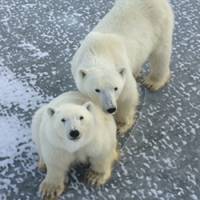
An international team of scientists has discovered that the female ancestor of all living polar bears was a brown bear that lived in present-day Britain and Ireland during the last ice age - 20,000 to 50,000 years ago. Changes in climate affecting the North Atlantic ice sheet probably gave rise to periodic overlaps in bear habitats.


Environment - Mar 27
The University of Manchester signs Memorandum of Understanding with United Utilities
The University of Manchester signs Memorandum of Understanding with United Utilities
Agronomy & Food Science - Mar 27
Gather & Gather unveils fresh new Spring/Summer 2026 menu designed for the warmer seasons
Gather & Gather unveils fresh new Spring/Summer 2026 menu designed for the warmer seasons
Environment - Mar 26
University of Manchester hits major sustainability milestone, with Main Campus becoming 100% 'Zero Landfill'
University of Manchester hits major sustainability milestone, with Main Campus becoming 100% 'Zero Landfill'
Campus - MANCHESTER - Mar 26
Manchester students mentor local teenagers to build confidence in applying for university
Manchester students mentor local teenagers to build confidence in applying for university