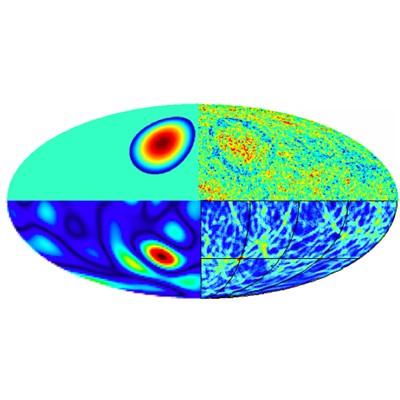
The signatures of a bubble collision at
various stages in the analysis pipeline. A collision (top left) induces a
temperature modulation in the CMB temperature map (top right). The ’blob’
associated with the collision is identified by a large needlet response (bottom
left), and the presence of an edge is highlighted by a large response from the
edge detection algorithm (bottom right). In parallel with the edge-detection tep, we perform a Bayesian parameter estimation and model selection analysis.
The theory that our universe is contained inside a bubble, and that multiple alternative universes exist inside their own bubbles ' making up the 'multiverse' ' is, for the first time, being tested by physicists. Two research papers published in Physical Review Letters and Physical Review D are the first to detail how to search for signatures of other universes. Physicists are now searching for disk-like patterns in the cosmic microwave background (CMB) radiation - relic heat radiation left over from the Big Bang - which could provide tell-tale evidence of collisions between other universes and our own. Many modern theories of fundamental physics predict that our universe is contained inside a bubble. In addition to our bubble, this `multiverse? will contain others, each of which can be thought of as containing a universe. In the other 'pocket universes' the fundamental constants, and even the basic laws of nature, might be different. Until now, nobody had been able to find a way to efficiently search for signs of bubble universe collisions - and therefore proof of the multiverse - in the CMB radiation, as the disc-like patterns in the radiation could be located anywhere in the sky.
TO READ THIS ARTICLE, CREATE YOUR ACCOUNT
And extend your reading, free of charge and with no commitment.