The findings suggest that the same equations used when designing propellers apply to swimming and flapping flight. By bridging this gap between biology and engineering, the study offers a roadmap for the next generation of ’bio-inspired’ technology, such as flapping drones and robotic fish.
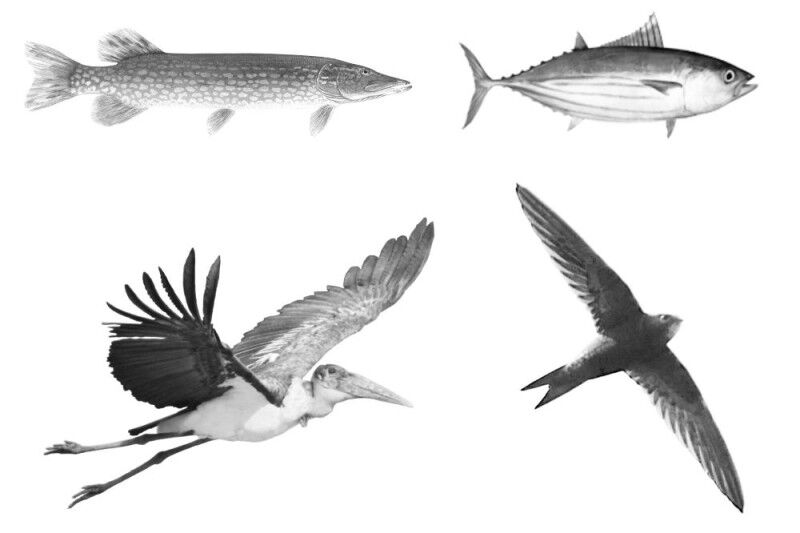
In the natural world, the broad tail of a pike (an acceleration specialist) looks nothing like the narrow, crescent-shaped tail of a tuna (a high-speed cruiser). Traditionally, scientists viewed the pike’s tail as a tool for ’raw power’ with a trade-off in terms of efficiency.
However, by applying propeller theory, Professor Jim Usherwood, Professor of Locomotor Biomechanics, has challenged the long-standing belief that certain animals sacrifice efficiency for raw power. Instead, his study has shown that whether an animal has broad, ’heavy-duty’ wings or fins, or slender, high-speed foils, both are optimised for maximum efficiency at their respective speeds.
In the case of the pike, its broad tail is the most efficient way to generate thrust at low speeds, and that as animals evolve to move faster, the mathematics of efficiency dictate a shift toward narrower, high-aspect-ratio shapes.
Published in the Royal Society journal, Interface, the study also provides a new explanation for one of nature’s most distinctive designs - the ’fingered’ wingtips of soaring birds like vultures and storks. These separated feathers, known as emarginate primaries, have long puzzled researchers, with some hypothesising that they act like winglets on a modern aeroplane to reduce drag.
However, this research suggests that these ’slotted’ wings act like high-performance fans - allowing large birds to be efficient in low flight speeds and also generate the massive thrust needed for loaded or rapid take-off. This also explains why these features are found not just in soarers, but in many game birds that need to burst into flight quickly.
Professor Jim Usherwood, Professor in Locomotor Biomechanics at the RVC, said:
"We’ve often looked at these different forms as a trade-off between acceleration and economy, but what the maths shows us is that there is no compromise.
"A pike is efficient at low speeds, where the thrust produces acceleration, while the tuna is efficient at high speeds, where the thrust overcomes drag. Efficiency is the rule; the right shape - and what they can use the thrust for - depends on speed."
Reference
Usherwood, J.R. (2026). Propeller efficiency and the spectrum of propulsor form with speed, from pike to tuna, vulture to swift. J. R. Soc. Interface. 10.1098/rsif.2025.0914.The full paper can be accessed at: https://doi.org/10.1098/rsif.2025.0914
Further background information can be found at:
https://www.rvc.ac.uk/research/projects/wings-and-fins
https://jimusherwoodresearch.com/wings-and-fins/
- Press Line: 0800 368 9520
About the RVC
- The Royal Veterinary College (RVC) is the UK’s largest and longest established independent veterinary school and is a Member Institution of the University of London.
- It is one of the few veterinary schools in the world that hold accreditations from the RCVS in the UK (with associated recognition from the AVBC for Australasia, the VCI for Ireland and the SAVC for South Africa), the EAEVE in the EU, and AVMA in the USA and Canada.
- The RVC is ranked as the top veterinary school in the world in the QS World University Rankings by subject, 2025.
- The RVC offers undergraduate and postgraduate programmes in veterinary medicine, veterinary nursing and biological sciences.
- The RVC is a research-led institution, with 88% of its research rated as internationally excellent or world class in the Research Excellence Framework 2021.
- The RVC provides animal owners and the veterinary profession with access to expert veterinary care and advice through its teaching hospitals and first opinion practices in London and Hertfordshire.