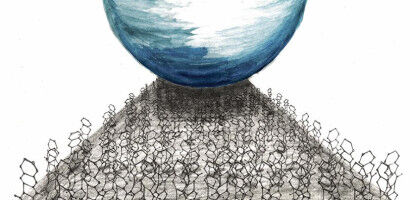
Part of the set-up for creating medium-density amorphous ice: ordinary ice and steel balls in a jar. Credit: Christoph Salzmann.From top: Part of the set-up for creating medium-density amorphous ice: ordinary ice and steel balls in a jar. Credit: Christoph Salzmann.
Part of the set-up for creating medium-density amorphous ice: ordinary ice and steel balls in a jar. Credit: Christoph Salzmann.From top: Part of the set-up for creating medium-density amorphous ice: ordinary ice and steel balls in a jar. Credit: Christoph Salzmann. Researchers at UCL and the University of Cambridge have discovered a new type of ice that more closely resembles liquid water than any other known ices and that may rewrite our understanding of water and its many anomalies. The newly discovered ice is amorphous - that is, its molecules are in a disorganised form, not neatly ordered as they are in ordinary, crystalline ice. Amorphous ice, although rare on Earth, is the main type of ice found in space. That is because in the colder environment of space, ice does not have enough thermal energy to form crystals.
TO READ THIS ARTICLE, CREATE YOUR ACCOUNT
And extend your reading, free of charge and with no commitment.