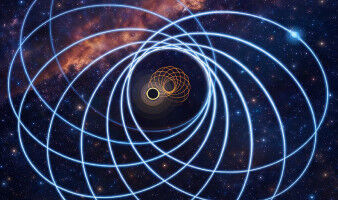
Artist's impression of the Gaia satellite with Milky Way stars in the background
Artist's impression of the Gaia satellite with Milky Way stars in the background - The European Space Agency's Gaia mission involving UCL researchers has released a new treasure trove of data about our home galaxy, including the largest chemical map ever produced and the full 3D motions of 35 million stars. Gaia is ESA's mission to create the most accurate and complete multi-dimensional map of the Milky Way. This allows astronomers to reconstruct our home galaxy's structure and past evolution over billions of years, and to better understand the lifecycle of stars and our place in the Universe. For the first time, the latest release of Gaia data, Data Release 3, contains the chemistry of stars, measured from high-resolution spectroscopy, a technique in which the starlight is split into its constituent colours (like a rainbow). The data reveals what six million stars are made of, as well as the speed at which 35 million stars are moving towards or away from us (the radial velocity) . This increases the number of radial velocities catalogued by a factor of five. Professor Mark Cropper (UCL Mullard Space Science Laboratory), who played a critical role in the development of the Gaia's Radial Velocity Spectrometer (RVS), said: "This is by far the largest catalogue of radial velocities, reaching out to the centre of the Milky Way, and out into its halo.
TO READ THIS ARTICLE, CREATE YOUR ACCOUNT
And extend your reading, free of charge and with no commitment.