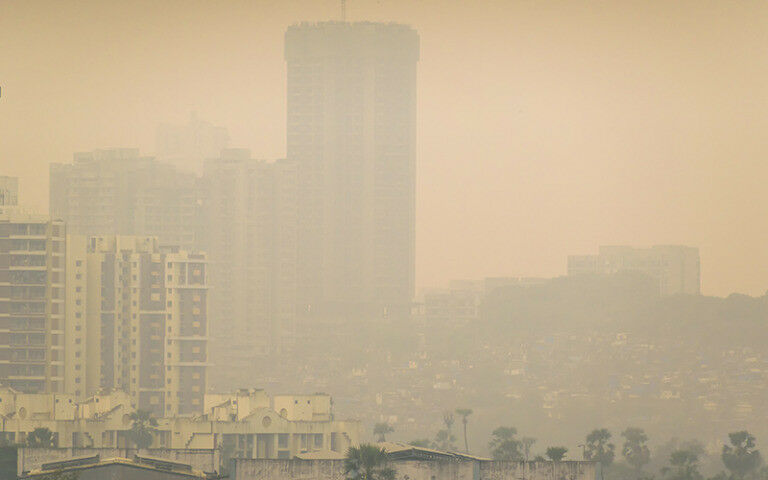
Mumbai, Maharashtra, India - October 2019: High air pollution and haze envelops the high rises in the suburb of Kandivali East.
Mumbai, Maharashtra, India - October 2019: High air pollution and haze envelops the high rises in the suburb of Kandivali East. Around 180,000 avoidable deaths over 14 years in fast-growing tropical cities were caused by a rapid rise in emerging air pollution, a study led by researchers at UCL and the University of Birmingham has revealed. The international team of scientists aimed to address data gaps in air quality for 46* future megacities in Africa, Asia and the Middle East using space-based observations from instruments onboard NASA and European Space Agency (ESA) satellites for 2005 to 2018. Published today in Science Advances , the study reveals rapid degradation in air quality and increases in urban exposure to air pollutants hazardous to health. Across all the cities, the authors found significant annual increases in pollutants directly hazardous to health of up to 14% for nitrogen dioxide (NO2) and up to 8% for fine particles (PM2.5), as well as increases in precursors of PM2.5 of up to 12% for ammonia and up to 11% for reactive volatile organic compounds. The researchers attributed this rapid degradation in air quality to emerging industries and residential sources like road traffic, waste burning, and widespread use of charcoal and fuelwood. Lead author Dr Karn Vohra (UCL Geography), who completed the study as a PhD candidate at the University of Birmingham, said: "Op en burning of biomass for land clearance and agricultural waste disposal has in the past overwhelmingly dominated air pollution in the tropics.
TO READ THIS ARTICLE, CREATE YOUR ACCOUNT
And extend your reading, free of charge and with no commitment.