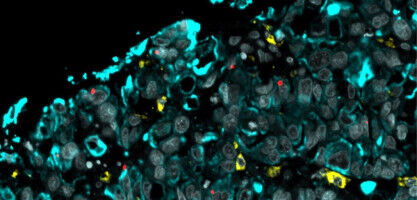
‘Molecular volume control’ may help combat tumours
A 'molecular volume control' may one day be used to manipulate enzyme activity in order control the development and treatment of cancer, according to research at the Universities of Dundee and Bath. The researchers have uncovered new functions of an enzyme called Dual-specificity phosphatase 5 (DUSP5), which will help scientists to better understand how tumours develop. DUSP5 is known to switch off the activity of another enzyme, called ERK, which controls cell growth in a number of cancers, including colon, lung and melanoma. This would suggest that DUSP5 is a tumour suppressor, but studies have also shown that increased DUSP5 activity is observed in several human cancers. Using cell-based models, the Dundee-Bath team have shown that the loss of DUSP5 can completely stop cancer cell formation by driving ERK activation to such high levels that it engages a natural protective mechanism within cells that makes them shut down. An analogy can be made to listening to the radio and being unable to hear comfortably when the volume is turned either too low or too high. In a similar manner, it appears that increasing or decreasing DUSP5 levels in cells can push ERK activity into ranges that are either too low or too high to cause cancer growth.