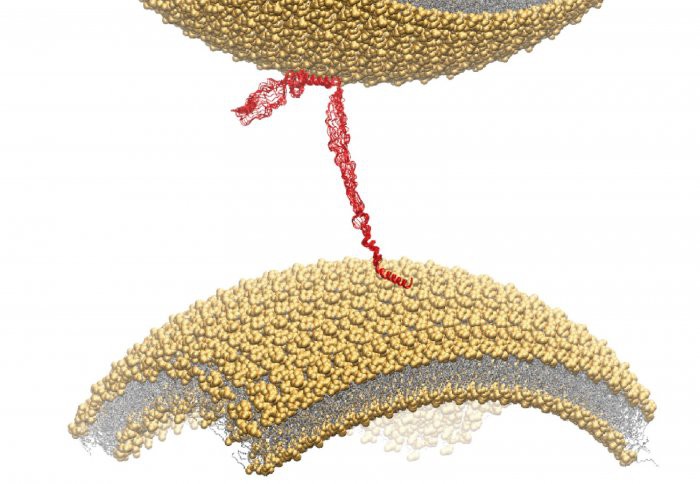
Alpha-synuclein (red) acts as a bond between cellular transporters in healthy brains
Researchers have uncovered the normal function of a protein associated with Parkinson's disease, giving clues about what happens when it malfunctions. By showing how the protein - called alpha-synuclein - works in healthy patients, the study offers important clues about what may be happening when it malfunctions and people develop the disease. While malfunctioning alpha-synuclein has long been recognised as a hallmark of Parkinson's disease, its role in healthy brains was not properly understood until now. The new study, carried out by researchers at Imperial College London and the University of Cambridge shows that the protein plays a vital role in signalling in the brain. If you remove part of a machine, you need to know what it is supposed to do before you can understand what the consequences of its removal are likely to be. Dr Alfonso De Simone The research team found that alpha-synuclein regulates the interaction between synaptic vesicles, which are small containers of neurotransmitters - the signalling chemicals of the brain. Alpha-synuclein helps to marshal the correct number of vesicles into the right position to release their neurotransmitters across junctions between nerve cells, known as synapses.
TO READ THIS ARTICLE, CREATE YOUR ACCOUNT
And extend your reading, free of charge and with no commitment.