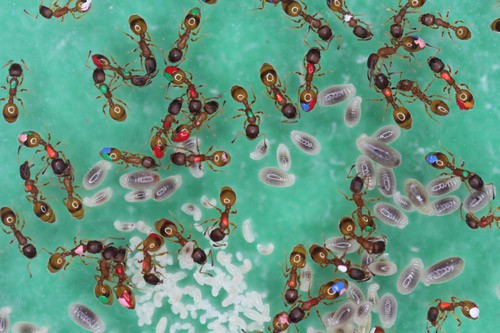
Individually paint-marked Temnothorax albipennis workers
Nigel R. Franks
We all know that social insects, such as ants, often work together to achieve effective responses to environmental challenges. However, research by the University of Bristol, published in the Journal of Experimental Biology, has now uncovered that the contributions of different individuals within such groups vary. In many cases, certain 'keystone' individuals conduct much more work than others, and are assumed to be disproportionately important to the collective response. Researchers examined this phenomena in 'tandem running' during colony emigrations in the ant species Temnothorax albipennis . Tandem running allows ants to lead their nest mates to a new home before the colony decides to emigrate, with more tandem runs being conducted the further away that new home is. Thomas O'Shea-Wheller from the School of Biological Sciences , said: "In our experiments, we individually paint-marked all of the ants in colonies, allowing us to determine the exact contribution that each worker made to the tandem running process. "We found that certain individuals were indeed highly active in tandem running, attempting significantly more tandem runs per ant.
TO READ THIS ARTICLE, CREATE YOUR ACCOUNT
And extend your reading, free of charge and with no commitment.