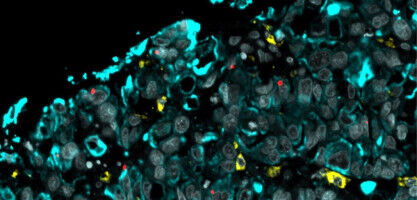
Zebrafish tail with faulty Popeye gene (top) and healthy tail (below)
Scientists have discovered a gene mutation that may trigger muscle and heart disorders. The findings, published in The Journal of Clinical Investigation , suggest that the gene, called Popeye domain containing-1, has a role in 'gluing' muscles cells together. When the gene is mutated, the muscle tissue becomes significantly weakened and damaged. The above image from the study shows the muscles in the tail of a Zebrafish with a mutated version of the gene, leading to damage in the tissue. The image below it shows a Zebrafish tail with a normal copy of the gene. The gene mutation was first discovered by researchers from the University of Ferrara, Italy, and the Beijing Genomics Institute, who studied the genetics of an Italian family who all suffer from muscular dystrophy. This condition leads to progressive weakening and damage of skeletal muscle - making movement and coordination difficult.
TO READ THIS ARTICLE, CREATE YOUR ACCOUNT
And extend your reading, free of charge and with no commitment.