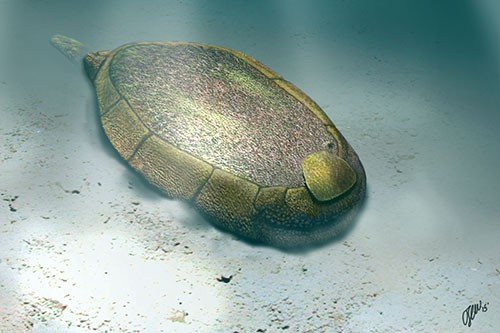
Reconstruction of Protocinctus mansillaensis in life position
O. Sanisidro
Scientists have used computer simulations to reconstruct feeding in the common ancestor shared between humans and starfish, which lived over half a billion years ago. The international team of researchers from the UK and Spain, led by Dr Imran Rahman from the University of Bristol, tested competing theories for feeding in a 510-million-year-old fossil using computational fluid dynamics, an engineering tool. The fossil under study is a 'primitive' relative of starfish and sea urchins and belongs to a group of marine animals known as echinoderms. It is thought to lie close to the base of the echinoderm tree of life. The results of the computer simulations show that the animal fed by actively drawing water into its mouth using internal gill slits, rather than passively waiting for food to come to it. Because the fossil represents one of the earliest ever echinoderms, this also suggests that the ancestor of echinoderms and vertebrates employed the same feeding strategy. The fossil is named Protocinctus mansillaensis and it belongs to an extinct group of echinoderms called cinctans.
TO READ THIS ARTICLE, CREATE YOUR ACCOUNT
And extend your reading, free of charge and with no commitment.