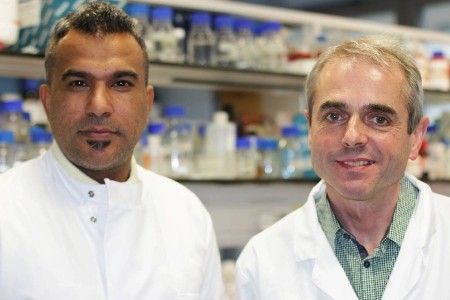
Majid Jabir and Tom Evans
Infection specialists have uncovered new evidence about how the human body's immune system responds to invading germs - a finding which could help combat hospital-acquired infections in future. The University of Glasgow team has been focusing on a particular pathogen - called Pseudomonas aeruginosa - which is the main cause of hospital-acquired pneumonia and has become increasingly resistant to antibiotics. Critically-ill patients who are ventilated in intensive-care units are particularly vulnerable to this infection. Now, however, a team led by Tom Evans, Professor of Molecular Microbiology, and Iraqi PhD researcher Majid Jabir, of the University's Institute of Infection, Immunity and Inflammation, have made an important breakthrough in understanding how the body's defensive response to infection works. Their findings, which have been published in the U.S. journal Cell Host and Microbe, could potentially lead to new treatments. Professor Evans explained: "Infection triggers a number of fundamental protective responses. One of these is the production of proteins, called 'cytokines', that help co-ordinate our immune system to combat invading pathogens." His team made what he describes as a "surprise finding" - that the activation system for producing certain cytokines in response to infection actually destroyed another key signalling protein within immune cells.
TO READ THIS ARTICLE, CREATE YOUR ACCOUNT
And extend your reading, free of charge and with no commitment.