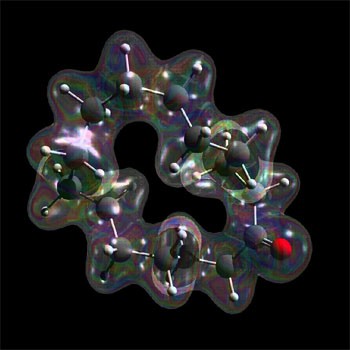
The
macrocyclic musk odorant cyclopentadecanone (Exaltone®) inside its electron
cloud. Structure calculated with Amsterdam Density Functional and rendered with Strata 3D .
Molecular vibrations, rather than molecular shape, give substances their distinct smell according to a new study by UCL scientists. In a study designed to find out how smell is written into a molecule's structure, scientists tested whether changing how a molecule vibrates on a nano-scale changes its smell. Molecules are made of atoms connected by bonds. The arrangement of bonds and atoms defines the vibration of the molecule. Chemists can therefore identify molecules by their vibrations, using a spectroscope. In an experiment, scientists took the musk molecule, which is commonly used in perfumery, and replaced the hydrogen atoms in the molecule with the heavier isotope deuterium. This exchange doubles the hydrogen atoms' mass, alters the molecule's molecular vibrations, but leaves the shape of the molecule unchanged. Results from the study appear to show that the deuterium musk molecules smell different to the hydrogen musk molecules, confirming that a molecule's molecular vibrations determine its smell. The study in published in the journal PLOS ONE. The study suggests that receptors in our nose are able to detect a nano-scale quantum mechanism called 'inelastic electron tunnelling' to detect molecular vibrations. First proposed at UCL in 1996, the idea was initially considered outlandish, although physicists confirmed the mechanism worked in theory. mell is the least understood of our senses. We can detect and identify tens of thousands of smelly molecules by smell alone. The greatest mystery can be summed up in one question: what makes a molecule smell of rose, lemon or rotten eggs?
TO READ THIS ARTICLE, CREATE YOUR ACCOUNT
And extend your reading, free of charge and with no commitment.