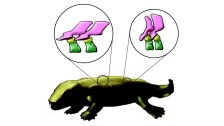
Rendering of the Ichthyostega backbone structure Credit: Julia Molnar
The results of this study force us to re-write the textbook on backbone evolution in the earliest limbed animals" - —Stephanie Pierce Research published today (Sunday 13 January 2013) in the journal Nature documents, for the first time, the intricate three-dimensional structure of the backbone in the earliest four-legged animals (tetrapods). The international team of scientists, led by Stephanie Pierce from the University's Zoology Department and the Royal Veterinary College and her Cambridge colleague Jennifer Clack, bombarded 360 million year old early tetrapod fossils with high energy synchrotron radiation. The resulting high resolution X-ray images allowed the researchers to reconstruct the backbones of the extinct animals in exceptional detail. The backbone, also known as the spine or vertebral column, is a bony structure found in all tetrapods, along with other vertebrates such as fish. It is formed from many elements or vertebrae all connected in a row - from head to tail. Unlike the backbone of living tetrapods (e.g. humans), in which each vertebra is composed of only one bone, early tetrapods had vertebrae made up of multiple parts.
TO READ THIS ARTICLE, CREATE YOUR ACCOUNT
And extend your reading, free of charge and with no commitment.