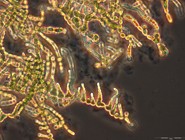
Multicellularity originated very early in cyanobacteria and likely had a strong influence on the early environment of our planet. It could have had advantages that helped to dominate environmental niches, increasing the abundance of cyanobacteria and subsequently oxygen production.
Multicellularity in cyanobacteria originated before 2.4 billion years ago and is associated with the accumulation of atmospheric oxygen, subsequently enabling the evolution of aerobic life, as we know it today, according to a new study from the University of Zurich involving researchers now at the University of Bristol , and Gothenburg. The research, published today in the Proceedings of the National Academy of Sciences ( PNAS ), applied phylogenetic tree reconstruction methods to the study of oxygen-producing bacteria, so-called cyanobacteria. These bacteria show an impressive morphological variety, including multiple forms of multicellularity, and are distributed across various habitats, including oceans, lakes, soil and even thermal vents. They are also amongst the oldest organisms on Earth and it seems that they are not only important for the ecosystem of our planet today but have been so for over two billion years. It has been suggested that cyanobacteria raised oxygen levels in the atmosphere around 2.4 billion years ago during the Great Oxidation Event (GOE), when the anoxic and seemingly uninhabitable Earth started to slowly accumulate oxygen in its atmosphere, finally forming the planet that we see today, full of diverse habitats and species. Yet, little was known about the temporal evolution of cyanobacterial lineages, and the possible interplay between the origin of multicellularity, diversification of cyanobacteria and the rise of atmospheric oxygen. By combining information gathered from ancient fossils and the genes of living organisms, the researchers tested whether the evolution of multicellularity overlaps with the GOE, and whether multicellularity is associated with significant shifts in diversification rates in cyanobacteria.
TO READ THIS ARTICLE, CREATE YOUR ACCOUNT
And extend your reading, free of charge and with no commitment.