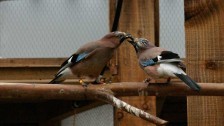
Eurasian Jay mating pair engaged in food-sharing Credit: Ljerka Ostojic
Our results raise the possibility that these birds may be capable of ascribing desire to their mates." - —Ljerka Ostojic New research shows that male Eurasian Jays in committed relationships are able to share food with their female partner according to her current desire. The behaviour suggests the potential for 'state-attribution' in these birds - the ability to recognise and understand the internal life and psychological states of others. The research was carried out in Nicola Clayton's Comparative Cognition lab at Cambridge University's Department of Psychology, and is published today in the journal PNAS. Researchers tested mated jays and separated males from females. The females were fed one particular larvae, either wax moth or mealworm - a treat for the birds, like chocolates - allowing the males to observe from an adjacent compartment through a transparent window. Once the pairs were reintroduced and the option of both larvae was presented, the males would choose to feed their partner the other type of larvae, to which she hadn't previously had access - a change in diet welcomed by the female.
TO READ THIS ARTICLE, CREATE YOUR ACCOUNT
And extend your reading, free of charge and with no commitment.