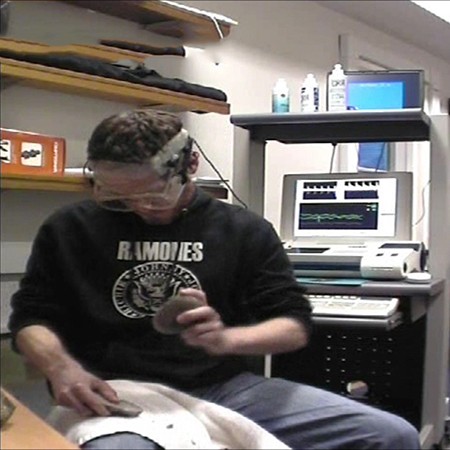
The brain activity of an experienced flint-knapper is monitored using a Transcranial Doppler Ultrasound, as he works the stone
Research by the University of Liverpool has found that the same brain activity is used for language production and making complex tools, supporting the theory that they evolved at the same time. Researchers from the University tested the brain activity of 11 expert stone tool makers (flint knappers) as they undertook a stone-making task and a standard language test. Brain blood flow activity measured They measured the brain blood flow activity of the participants as they performed both tasks using functional Transcranial Doppler Ultrasound (fTCD), commonly used in clinical settings to test patients' language functions after brain damage or before surgery. The researchers found that brain patterns for both tasks correlated, meaning that they both use the same area of the brain. Language and stone tool-making are considered to be unique features of humankind that evolved over millions of years. Darwin was the first to suggest that tool-use and language may have co-evolved, because they both depend on complex planning and the coordination of actions but until now there has not been any evidence to support this. Dr Georg Meyer , from the University Department of Experimental Psychology , said: "This is the first study of the brain to compare complex tool-making directly with language.
TO READ THIS ARTICLE, CREATE YOUR ACCOUNT
And extend your reading, free of charge and with no commitment.