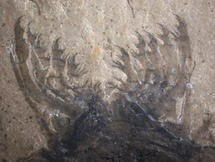
Fossil of Sanctacaris uncata, which the study suggests is a putative ancestor of modern spiders and horseshoe crabs. (Image: David Legg)
A study by an Oxford University researcher has shed new light on the origins of modern animal groups including insects and spiders. The paper shows that insects evolved from a marine crustacean ancestor, while spiders evolved from a trilobite-like ancestor. Based on analysis of more than 750 anatomical features in over 300 species, more than 200 of which are fossils, the results support previous hypotheses on the evolution of arthropods produced using molecular techniques such as DNA sequencing. Until now, molecular techniques and anatomical data had often resulted in widely divergent hypotheses. Lead author Dr David Legg, who recently joined the Oxford University Museum of Natural History as a research fellow, said: 'Using our data set, which is the largest of its kind, we have been able to resolve the discrepancy that has existed for many years between the molecular evidence and the anatomical evidence. 'We show that, for example, everyday insects such as flies and wasps are closely related to prawns, crabs and lobsters, which backs up the majority of molecular evidence. 'This is the first time the controversial molecular results have been verified using anatomical information - thanks to the inclusion of fossils.
TO READ THIS ARTICLE, CREATE YOUR ACCOUNT
And extend your reading, free of charge and with no commitment.