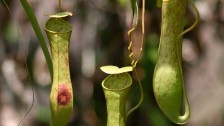
N. Gracilis Image credit: Dr Ulrike Bauer
It all started with the observation of a beetle seeking shelter under a N. gracilis lid during a tropical rainstorm. Instead of finding a safe - and dry - place to rest, the beetle ended up in the pitcher fluid, captured by the plant." - —Dr Ulrike Bauer from the University of Cambridge's Department of Plant Sciences During heavy rain, the lid of Nepenthes gracilis pitchers acts like a springboard, catapulting insects that seek shelter on its underside directly into the fluid-filled pitcher, new research has found. Pitcher plants ( Nepenthes ) rely on insects as a source of nutrients, enabling them to colonise nutrient-poor habitats where other plants struggle to grow. Prey is captured in specialised pitcher-shaped leaves with slippery surfaces on the upper rim and inner wall, and drowns in the digestive fluid at the bottom. Under humid conditions, the wettable pitcher rim is covered by a very thin, continuous film of water. If an insect tries to walk on the wet surface, its adhesive pads (the 'soles' of its feet) are prevented from making with the surface and instead slip on the water layer, similar to the 'aquaplaning' effect of a car tire on a wet road. However, researchers have now discovered a new, unique method of capturing insects by the pitcher plant Nepenthes gracilis .
TO READ THIS ARTICLE, CREATE YOUR ACCOUNT
And extend your reading, free of charge and with no commitment.