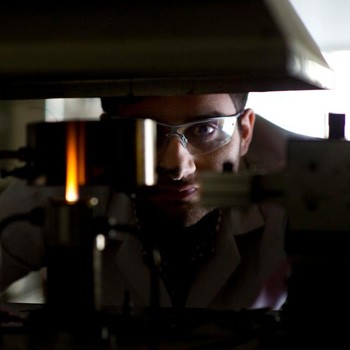
Atif Elahi, a co-author on the paper, in the lab
Chemists at UCL have discovered a new property of flames, which allows them to control reactions at a solid surface in a flame and opens up a whole new field of chemical innovation. Published in the journal Angewandte Chemie, authors of the new study have discovered their previous understanding of how flames interact with a solid surface was mistaken. For the first time, they have demonstrated that a particular type of chemistry, called redox chemistry, can be accurately controlled at the surface. This finding has wide implications for future technology, for example in detection of chemicals in the air, and in developing our understanding of the chemistry of lightning. It also opens up the possibility of being able to perform nitrogen oxide and carbon dioxide electrolysis at the source for the management of green house gases. Results of the study show that depending on the chemical make-up of the flame, scientists can record a distinctive electrical fingerprint. The fingerprint is a consequence of the behaviour of specific chemical species at the surface of a solid conducting surface, where electrons can exchange at a very precise voltage.
TO READ THIS ARTICLE, CREATE YOUR ACCOUNT
And extend your reading, free of charge and with no commitment.