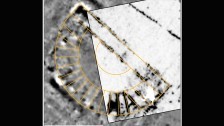
An image of the theatre at Interamna Lirenas, in Southern Lazio, which emerged from the latest study. The grey background shows the magnetrometry image which revealed that a large building was on that spot. The white square is taken from a Ground Penetrating Radar survey (GPR) which showed the shape and dimensions of the building in more detail. This revealed it to be a Roman theatre, marked in yellow. Credit: University of Cambridge.
An ancient Italian town whose remains are buried beneath the earth has been mapped by a team of researchers, revealing evidence of a bustling social and economic settlement 1,500 years ago. Having the complete streetplan and being able to pick out individual details allows us to start zoning the settlement and examine how it worked and changed through time." - —Martin Millett An ancient Italian town, which disappeared after its abandonment 1,500 years ago and now lies buried underground, has been mapped by researchers, revealing the location of its theatre, marketplace and other buildings. Originally founded as a Roman colony in the 4th century BCE, the site of Interamna Lirenas lies in the Liri Valley in Southern Lazio, about 50 miles south of Rome itself. After it was abandoned around the year 500 CE, it was scavenged for building materials and, over time, its remains were completely lost from view. Today, the site is an uninterrupted stretch of farmland, with no recognisable archaeological features. Now, researchers have successfully produced the first images of the ancient site, using geophysical methods that allowed them to look beneath the surface of the earth and map the layout of the entire settlement, which spans 25 hectares. The resulting pictures have already thrown up a few surprises.
TO READ THIS ARTICLE, CREATE YOUR ACCOUNT
And extend your reading, free of charge and with no commitment.