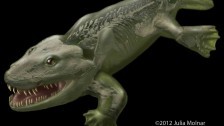
flesh-reconstruction_copyright_Julia-Molnar Copyright Julia Molnar
Our reconstruction demonstrates that the old idea, often seen in popular books and museum displays, of Ichthyostega looking and walking like a large salamander, with four sturdy legs, is incorrect." - —Professor Jennifer Clack An ancient four-limbed creature that's thought to be the first ever to walk on land couldn't actually walk at all, researchers have discovered. Instead, they think the animal, which scientists call an early tetrapod, simply hauled itself out of the primordial ooze with its two front limbs, using its back limbs merely for balance. "These early tetrapods probably moved in a similar way to living mudskipper fishes in which the front fins, or arms, are used like crutches to haul the body up and forward,” explains Stephanie Pierce from The Royal Veterinary College and University of Cambridge, lead author of Pierce and co-authors, Professor Jennifer Clack from the University of Cambridge and Professor John Hutchinson form The Royal Veterinary College, made their discovery by creating the first ever 3D computer model of an early tetrapod's skeleton. Their aim was to work out how its limbs might have moved. They scanned dozens of fossil specimens of a tetrapod that lived around 360 million years ago called Ichthyostega . They digitally separated the bones from the rock surrounding the fossils.
TO READ THIS ARTICLE, CREATE YOUR ACCOUNT
And extend your reading, free of charge and with no commitment.