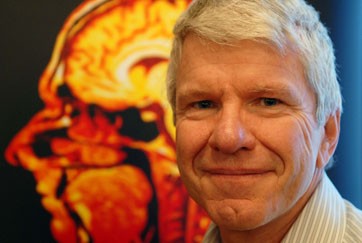
Mike Owen
Genetic mutations that cause schizophrenia could be linked to systems in the brain responsible for learning and memory, a major University study suggests. Leading researchers from the University's MRC Centre for Neuropsychiatric Genetics & Genomics have identified changes to genes - genetic mutations - in patients with schizophrenia who had not inherited the condition. The study, published in the journal Molecular Psychiatry, showed that these mutations occurred among a set of proteins that play a key role in memory function. The scientists took samples of DNA from more than 650 patients with schizophrenia and compared these with DNA from their parents - who did not have the condition - to identify the genetic differences. Professor Michael Owen, who led the research with colleague Professor Michael O'Donovan, said: "By studying such a large sample we have been able to provide the first clear insights into the sorts of basic biological processes that underlie schizophrenia. "We hope that by identifying these mutations our findings will help us understand more clearly how schizophrenia arises and ultimately identify new targets for treatments." The task of identifying what causes schizophrenia is difficult because the disorder does not occur as a result of a single genetic mutation, but reflects a large number of different risk genes. The genetic mutations disrupt the production of proteins found at synapses, which are the connections between different brain cells.
TO READ THIS ARTICLE, CREATE YOUR ACCOUNT
And extend your reading, free of charge and with no commitment.