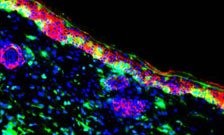
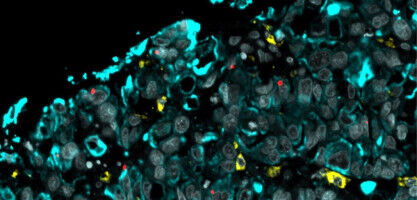
Bone marrow cells (green) can regenerate skin
Researchers at King's College London and Osaka University in Japan have identified specific bone marrow cells that can transform into skin cells to repair damaged skin tissue, according to a study published today in the journal, Proceedings of the National Academy of Sciences (PNAS) . The team has uncovered how this process works, providing new insights into the mechanisms behind skin repair. This significant advance has the potential to revolutionise approaches to wound treatment in the future, which could benefit people with chronic wounds such as leg ulcers, pressure sores and burns, as well as genetic skin diseases such as epidermolysis bullosa, which causes painful blisters on the skin. The current management of chronic wounds in UK patients costs more than a billion pounds every year so this new scientific discovery could lead to significant future cost savings for the NHS. It was already known that bone marrow may play a role in skin wound healing, but until now it was not known which specific bone marrow cells this involves, how the process is triggered, and how the key cells are recruited to the affected skin area. The team of researchers carried out experiments in mice, specifically looking at the mechanisms involved when skin grafts are used, compared with non-grafted wound healing. The findings showed that in mice with non-grafted wound healing, very few bone marrow cells travelled to the wound to repair it and they did not make a major contribution to epidermal repair.
TO READ THIS ARTICLE, CREATE YOUR ACCOUNT
And extend your reading, free of charge and with no commitment.