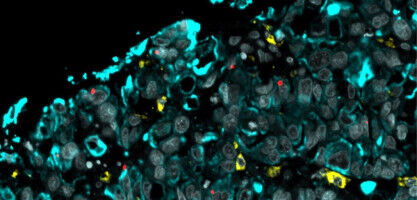
Coloured microscope image of a pilus (blue) protruding from a Pseudomonas syringae cell (left). Image provided by Prof. John Mansfield.
Pair of genes makes plant pest double trouble. Research at Imperial could help scientists control one of the world's most important crop diseases, Pseudomonas Syringae - News Monday 7 February 2011 - Adapted from a news release issued by the Biotechnology and Biological Science Research Council (BBSRC). Researchers from Imperial College London have revealed this week how two genes in the bacteria Pseudomonas syringae work together to trigger an infection responsible for a range of deadly plant diseases. Pseudomonas causes disease outbreaks in rice, tomatoes, corn, cucumbers and beans, as well as many wild plants, and has now infected half of all horse chestnut trees in the UK. The British Society for Plant Pathology has rated P. syringae as the most important plant pathogen worldwide. The researchers hope that their gene discovery explaining how the bacteria attack plant cells so effectively will help them find new targets for pesticides and devise better strategies for disease management. P. syringae have a sophisticated system for infecting plants: they possess tiny needle-like structures called pili which they use to inject a plant with a range of proteins which suppress its immune response and kill cells.
TO READ THIS ARTICLE, CREATE YOUR ACCOUNT
And extend your reading, free of charge and with no commitment.