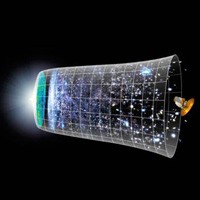
Representation of the timeline of the universe over 13.7 billion years
Remnants of the first stars have helped astronomers get closer to unlocking the "dark ages" of the cosmos. A team of researchers from the University of Cambridge and California Institute of Technology are using light emitted from massive black holes called quasars to "light up" gases released by the early stars, which exploded billions of years ago. As a result, they have found what they refer to as the missing link in the evolution of the chemical universe. The first stars are believed to hold the key to one of the mysteries of the early cosmos: how it evolved from being predominantly filled with hydrogen and helium to a universe rich in heavier elements, such as oxygen, carbon and iron. However, although telescopes can detect light reaching Earth from billions of light-years away, enabling astronomers to look back in time over almost all of the 13.7-billion-year history of the universe, one observational frontier remains: the so-called "dark ages". This period, lasting half a billion years after the Big Bang, ended when the first stars were born and is inaccessible to telescopes because the clouds of gas that filled the universe were not transparent to visible and infrared light. "We have effectively been able to peer into the dark ages using the light emitted from a quasar in a distant galaxy billions of years ago.
TO READ THIS ARTICLE, CREATE YOUR ACCOUNT
And extend your reading, free of charge and with no commitment.