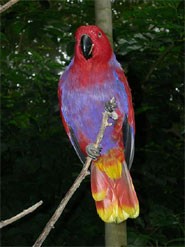
When mothers choose the sex of their offspring, sexual selection collapses and male courtship displays disappear. This is because females no longer find the displays attractive.
The gaudy plumage and acrobatic displays of birds of paradise are a striking example of sexual selection, Charles Darwin's second great theory of evolution. But new research shows that this powerful process may collapse when mothers can decide whether to have a son or a daughter. Choosing the sex of our offspring may seem totally beyond our control, but some animals have a remarkable capacity to manipulate this. The female eclectus parrot, for example, has been known to produce 20 sons in a row before switching to producing only daughters. Now, a team of evolutionary biologists has found that tight control over offspring sex ratios can have disastrous consequences for sexual selection. Led by Tim Fawcett , a research fellow at the University of Bristol, the team used mathematical models and computer simulations to investigate how sex-ratio control and sexual selection interact. With sex ratios fixed at 50-50, the scientists found the classical pattern of sexual selection, with males evolving elaborate courtship displays to attract females.
TO READ THIS ARTICLE, CREATE YOUR ACCOUNT
And extend your reading, free of charge and with no commitment.