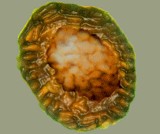
Cluster of cells. Credit: Oxford University/Martin Brasier
Loch fossils show life harnessed sun and sex early on. Remote lochs along the west coast of Scotland are turning up new evidence about the origins of life on land. A team of scientists from the University of Sheffield, the University of Oxford and Boston College, who are exploring rocks around Loch Torridon, have discovered the remarkably preserved remains of organisms that once lived on the bottom of ancient lake beds as long as a billion (1,000 million) years ago. These fossils illuminate a key moment in the history of evolution when life made the leap from tiny, simple bacterial (prokaryote) cells towards larger, more complex (eukaryotic) cells which would make photosynthesis and sexual reproduction possible. The findings are reported in today's (13 April 2011) Nature . Some of these ancient fossils are so finely ornamented, and so large and complex, that they are evidence for a surprisingly early start for the emergence of complex eukaryote cells on land. The researchers believe that it was from complex cells such as these that green algae and green land plants – everything from lettuce to larch trees – were able to evolve and colonise the land.
TO READ THIS ARTICLE, CREATE YOUR ACCOUNT
And extend your reading, free of charge and with no commitment.